

ESF Overview
A clear vision for what districts and schools across the state do to ensure an excellent education for all Texas students.
Effective School Framework Impact Model
How the Framework Works
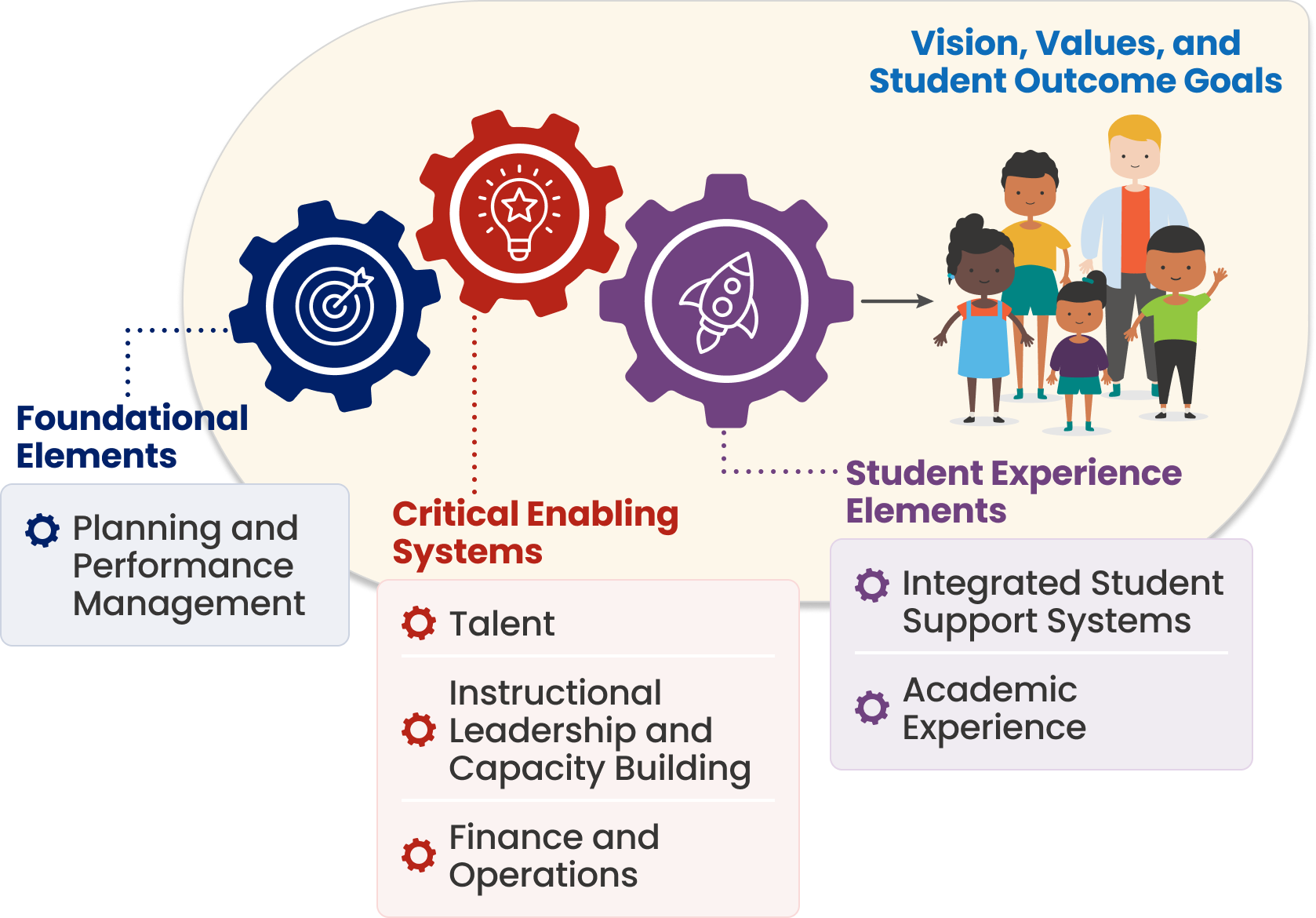
Within these three components, you will find the Levers that make up the EDF. All these components work together to achieve the vision, values, and student outcome goals. The EDF Impact Model uses cogs to illustrate the interconnected nature of these components. If one cog stops, the others will halt; if one speeds up, the others may become erratic. This model demonstrates how each component supports one another to support districts in achieving their envisioned student experience.
Student Experience Elements
The impact model highlights how the vision, values, and student outcome goals are driven by the student experience, illustrated by the children on the model. The student experience is nurtured through integrated support systems and a rigorous academic experience, represented by the purple cog. Systems within this component directly impact the student experience.
Critical Enabling Systems
For the student experience elements component to be effective, there are critical enabling systems that must be in place, illustrated by the red cog. These include talent, instructional leadership and capacity building, and finance and operations. These critical enabling systems support systems established in the student experience elements component.
Foundational Elements
Additionally, foundational elements, illustrated by the blue cog are essential in providing a foundation for districts to plan and performance manage systems established in the other components. Without effective performance management systems, we cannot truly advance towards our vision, values, and student outcome goals.
The ESF Structure
The ESF mirrors the organizning structure of the Effective District Framework.
District Commitments
District commitments describe what local education agencies do to ensure that schools are set up for success.
Lever
The lever is the largest category that high-performing schools focus on. The ESF is made up of six levers. The components in each lever are the actionable elements to improve student outcomes.
Essential Action
The Essential Actions describe what the most effective districts do to support powerful teaching and learning under a specific lever.
Key Practice
Each Essential Action includes a set of Key Practices that define what the essential action entails when implemented with fidelity. Distrcit leaders can utilize Key Practices to define action steps taken to achieve Essential Action Practices.
Success Criteria
The Success Criteria further defines the Key Practice as “look fors” or evidence. If the Key Practice is being implemented with fidelity, the success criteria can be collected or observed as evidence of success.

Foundational Elements
Lever 1
Planning and Performance Management through Strong Leadership
The campus aligns its goals and priorities with the district’s vision for student success. It develops actionable campus plans that include key strategies and incorporates planning and performance management routines to monitor initiative progress and student achievement.
Vision and Mission
Understand the district’s vision for student success.
Campus Improvement Plan
Develop a Campus Improvement Plan aligned to the district’s strategic plan.
Campus Implementation Planning and Project Management
Plan for and project management implementation of prioritized district initiatives.
Performance Management of Campus Improvement Plans/Goals
Performance Management of Campus Improvement Plans/Goals

Critical Enabling Systems
Lever 2
Talent Retention and Strategic Staffing
The campus prioritizes effective staffing practices such as intentional talent retention and strategic staffing strategies in alignment with district guidelines to ensure the needs of all students are met.
Intentional Roles and Staffing
Staff are strategically hired and placed to deliver on the envisioned student experience
Staff Selection
Intentionally selects educators well-prepared to provide high-quality instruction and services to each student.
Growth and Retention Strategies
Systems in place to support teacher professional growth, advancement opportunities, and retention.

Student Experience Elements
Lever 3
Integrated Student Support Systems
The campus establishes proactive and responsive student support systems aligned to the district’s MTSS framework, promoting a positive school culture, supports for all students, and family engagement.
Multi-tiered System of Supports
Implement the district’s integrated multi-tiered system of supports (MTSS) framework aligned to evidence-based prevention and intervention practices to support the academic and non-academic needs of all students, providing guidance on routine progress monitoring and data-driven decision making.
School-wide Culture, Behavior, Safety
Establish strong school culture, behavior, and safety systems.
Interventions and Supports
Staff identify and respond to needs of all students and provide timely targeted responses to reduce barriers to learning and promote trust, belonging, safety, growth mindset, and self-regulation.
Student Experience Elements
Lever 4
Academic Experience: High Quality Instructional Materials
The campus implements the district’s framework for strong instruction by applying research-based strategies and using high-quality instructional materials and assessments to deliver a rigorous academic experience for all students, ensuring they are supported and prepared for college, career, or military pathways.
Multi-tiered Academic Experience
Implement a research-based strategy and approach for strong multi-tiered instruction and supports.
Management of Curriculum Implementation
Monitors curriculum implementation and ensures access to curriculum materials.
CCMP Course Offerings and Graduation Programs of Study
All students are provided with individual career and academic planning and meaningful advising experiences leading to informed decision-making and successful navigation to and through their chosen pathway.
Critical Enabling Systems
Lever 5
Instructional Leadership and Capacity Building
The campus implements systems aligned with the district expectations to build teacher and instructional leader capacity through job-embedded opportunities such as collaborative planning and internalization, observation and feedback cycles, and data analysis protocols.
Instructional Leadership
Establish expectations and campus systems for instructional leaders and teachers’ coaching and development.
Instructional Planning for Effective Classroom Instruction
Provide job-embedded supports for teachers to effectively internalize, prepare for, and deliver instruction in a strong classroom environment.
Data-Driven Instruction, Assessment Reflection, and Targeted Supports
Campus utilizes data to support all learners.
Critical Enabling Systems
Lever 6
Campus Finance and Operations
The campus maintains strong financial and operational systems aligned with district systems, prioritizing strategic budget allocation to support the envisioned student experience, maximizing instructional time, fostering student-focused enrollment practices, and maintaining a safe and secure learning environment.
Teacher and Student Time
Campus ensures there is sufficient time in the school day for impactful student experiences, as well as staff preparation and development.
Campus Budget
Strategically plans for and allocates resources in alignment with the envisioned student experience.
Enrollment and Access
A clearly defined process for enrollment and access that aligns with district expectations and established procedures.
Campus Operations
Strategically plans and allocates resources in alignment with the envisioned student experience.