
Lever 3
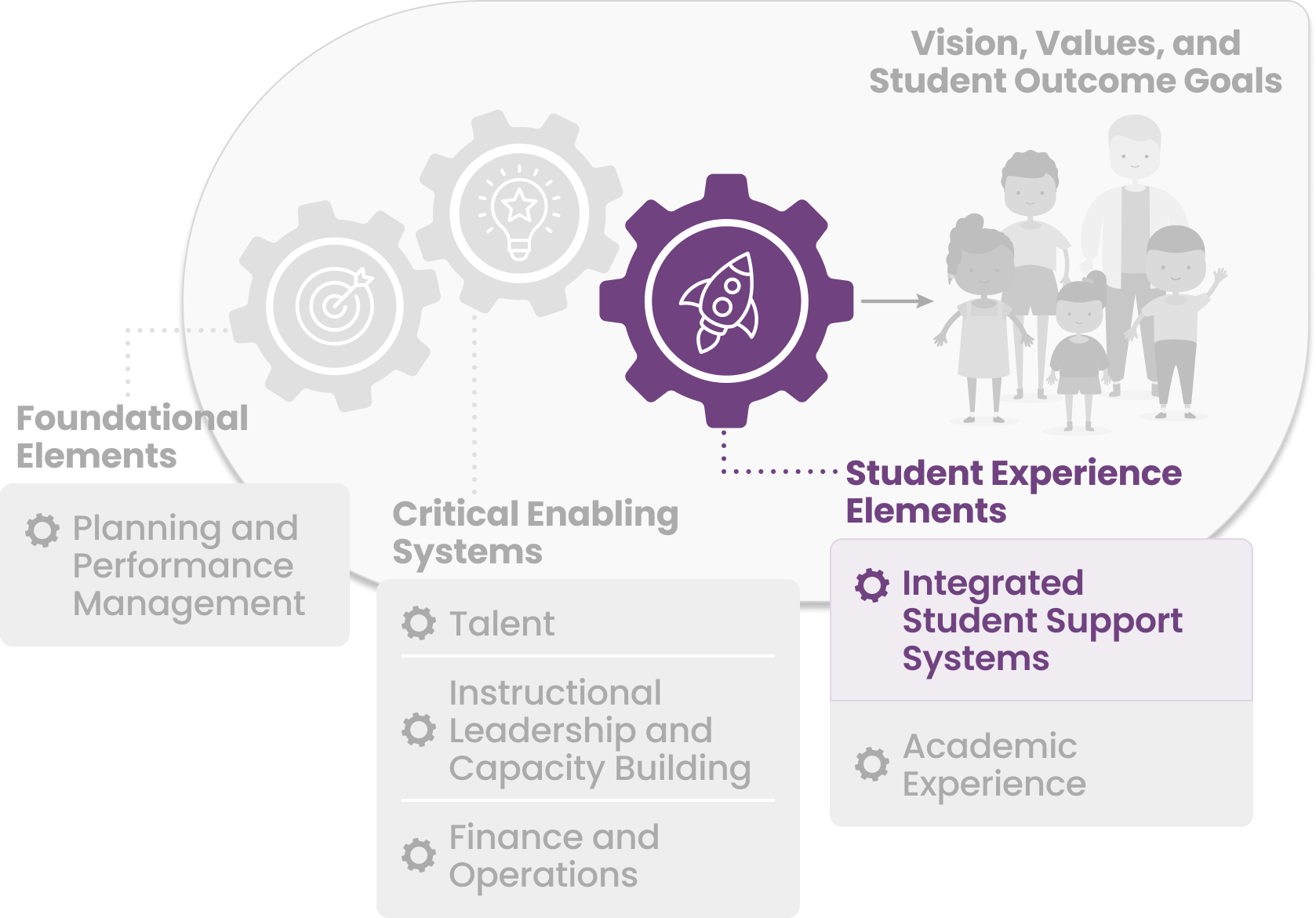
Integrated Student Support Systems
The campus establishes proactive and responsive student support systems aligned to the district’s MTSS framework, promoting a positive school culture, supports for all students, and family engagement.
District Commitments
The district establishes proactive and responsive holistic student supports to provide student supports focusing on a positive school culture by developing, implementing, and monitoring behavior and safety plans, empowering staff to address student needs Pre-K through 12th grade.
This commitment includes systems, guidance and expectations in the following areas:
- Framework for a Comprehensive Multi-tiered System of Supports (EDF, 3.1)
- School-wide Culture, Behavior, Safety (EDF, 3.2)
- Interventions and Support (EDF, 3.3)
- Early Childhood (EDF, 3.4)
Essential Actions and Key Practices
Each lever is defined by a set of Essential Actions (EA) and Key Practices (KP) that describe what effective implementation looks like on a campus. Together, these components provide clear guidance for how systems and practices come to life to support strong student outcomes.
Multi-tiered System of Supports
KP 3.1.1 Student Support Teams
Campus student support teams meet regularly, following the district’s SST structure, to review data, identify individual students’ academic, behavioral, and foundational strengths, and implement individualized support strategies.
KP 3.1.2 Universal Screening
Campus administers district-wide universal screeners for academic, optional mental health, and behavior to support early identification and intervention.
KP 3.1.3 Family Engagement
Campus fosters an inclusive environment by actively engaging families in supporting students’ academic growth and overall well-being through regular, personalized communication, which is outlined as an expectation for all teachers.
School-wide Culture, Behavior, Safety
KP 3.2.1 School-wide Culture
Campus-level culture-setting aligned to district-level guiding commitments and vision and supports student readiness to learn.
KP 3.2.2 Routines for a Productive Learning Environment
Campus staff follow clear expectations for implementing school-wide and classroom-level procedures, with opportunities to practice, to ensure a safe and productive learning environment.
KP 3.2.3 Universal Behavior and Discipline Strategies
Campus leaders establish and communicate clear expectations for prevention, incentives, and consequences that promote positive behavior for all students.
Interventions and Supports
KP 3.3.1 Case Management
Campus leaders ensure that a case management system is used to monitor student progress by reviewing academic data, universal screener results, behavior, attendance, student well-being, and access to support, enabling timely and targeted interventions.
KP 3.3.2 Integrated Mental Health and Crisis Response
Campus provides proactive, policy-aligned mental health education for all students and uses evidence-based practices (interventions) to address threat concerns through district-designated crisis teams that conduct structured threat assessments and provide trauma-informed postvention and re-entry support.