

Lever 5
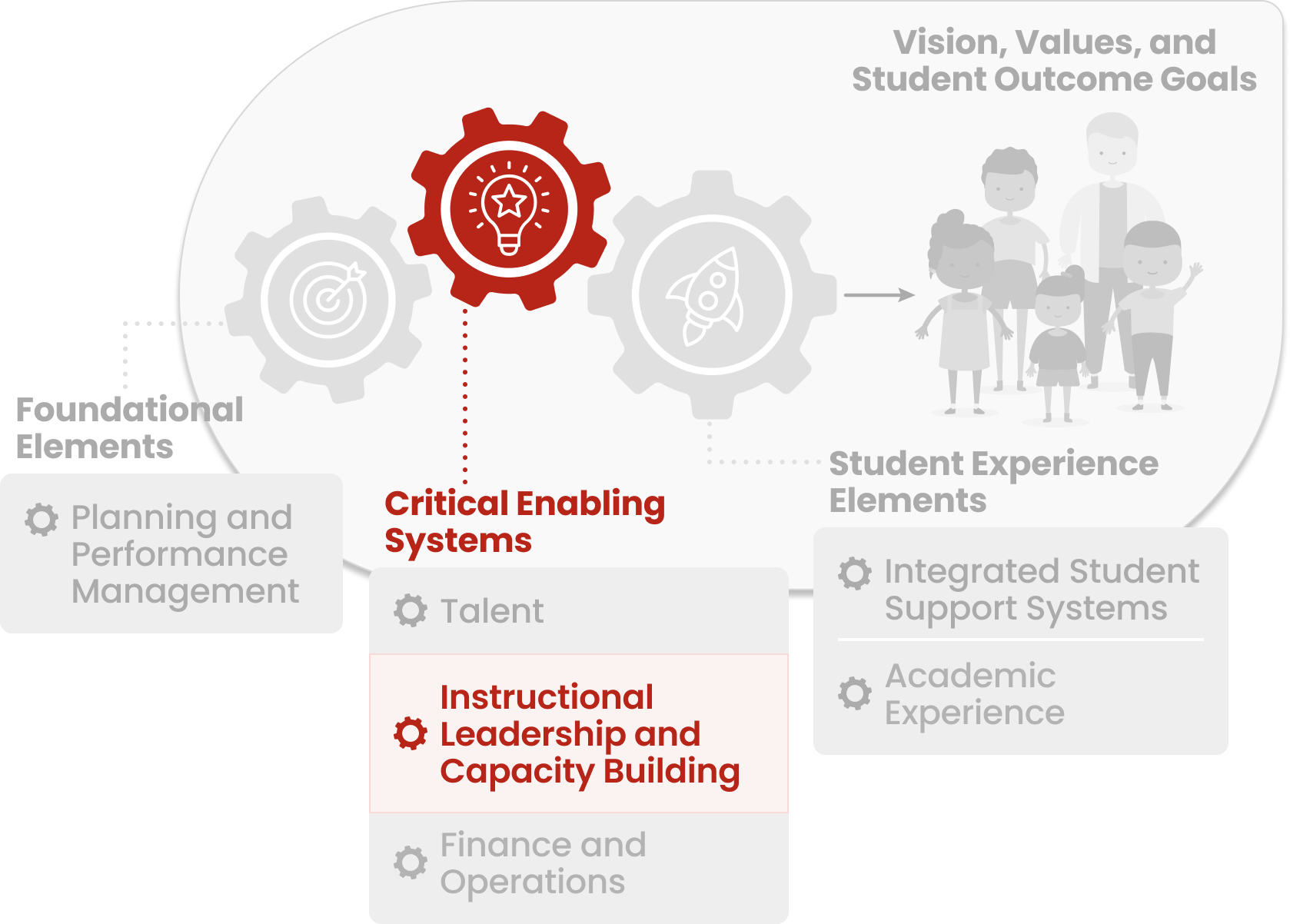
Instructional Leadership and Capacity Building
The campus implements systems aligned with the district expectations to build teacher and instructional leader capacity through job-embedded opportunities such as collaborative planning and internalization, observation and feedback cycles, and data analysis protocols.
District Commitments
Systems are established to enable instructional leadership development and capacity building for instructional leaders and teachers, including planning, internalization, and effective delivery of instruction. The district ensures foundational practices support data-driven instruction and assessment reflection benefiting all learners.
This commitment includes systems, guidance and expectations in the following areas:
- Instructional Leadership and Development Enabling Conditions (EDF, 5.1)
- Instructional Planning and Delivery (EDF, 5.2)
- Data-Driven Instruction, Assessment Reflection, and Targeted Supports (EDF, 5.3)
Essential Actions and Key Practices
Each lever is defined by a set of Essential Actions (EA) and Key Practices (KP) that describe what effective implementation looks like on a campus. Together, these components provide clear guidance for how systems and practices come to life to support strong student outcomes.
Instructional Leadership
KP 5.1.1 Roles and Responsibilities for Distributed Leadership
Campus sets and reinforces high performance expectations by following district guidance during hiring, onboarding/induction, professional learning, and coaching structures.
KP 5.1.2 Staff Development and Coaching Plan
Campus leadership ensures staff are supported through deliberately scheduled, ongoing, job-embedded coaching and professional development that supports rigorous, high-quality instruction.
Instructional Planning for Effective Classroom Instruction
KP 5.2.1 Culture and Routine Systems Training
Campus leadership ensures all teachers and instructional staff receive role aligned training on campus specific culture routines and behavior supports, aligned with district expectations
KP 5.2.2 Curriculum-based Professional Learning
Campus leaders provide additional resources and support for teachers to effectively implement adopted instructional materials
KP 5.2.3 Instructional Delivery Training
Campus instructional leaders ensure teachers receive role-specific training focused on strong instruction, classroom management, intervention strategies, and support for special populations.
KP 5.2.4 Instructional Planning Supports
Campus leadership supports teachers in internalizing curriculum through structured individual planning time and PLCs.
KP 5.2.5 Observation and Feedback
Campus instructional leaders implement observation and feedback cycles with calibration aligned to high-quality instructional material delivery and strong instructional delivery practices, leveraging action step trackers to provide clarity and track progress over time.
Data-Driven Instruction, Assessment Reflection, and Targeted Supports
KP 5.3.1 Data-Driven Instruction with Curriculum-Embedded Assessments
Campus instructional leaders implement systems for teachers to analyze exit ticket data, review student work, and use formative assessments to identify learning gaps, plan targeted supports, and adjust instruction in alignment with high-quality instructional materials.
KP 5.3.2 Data-Driven Instruction, Assessment Reflection, and Targeted Supports
Campus instructional leaders use disaggregated data to monitor student progress, provide evidence-based feedback, and guide teachers—individually and in PLCs—through a consistent process to analyze misconceptions, identify root causes, and plan targeted instructional responses. .